

AI Transformation
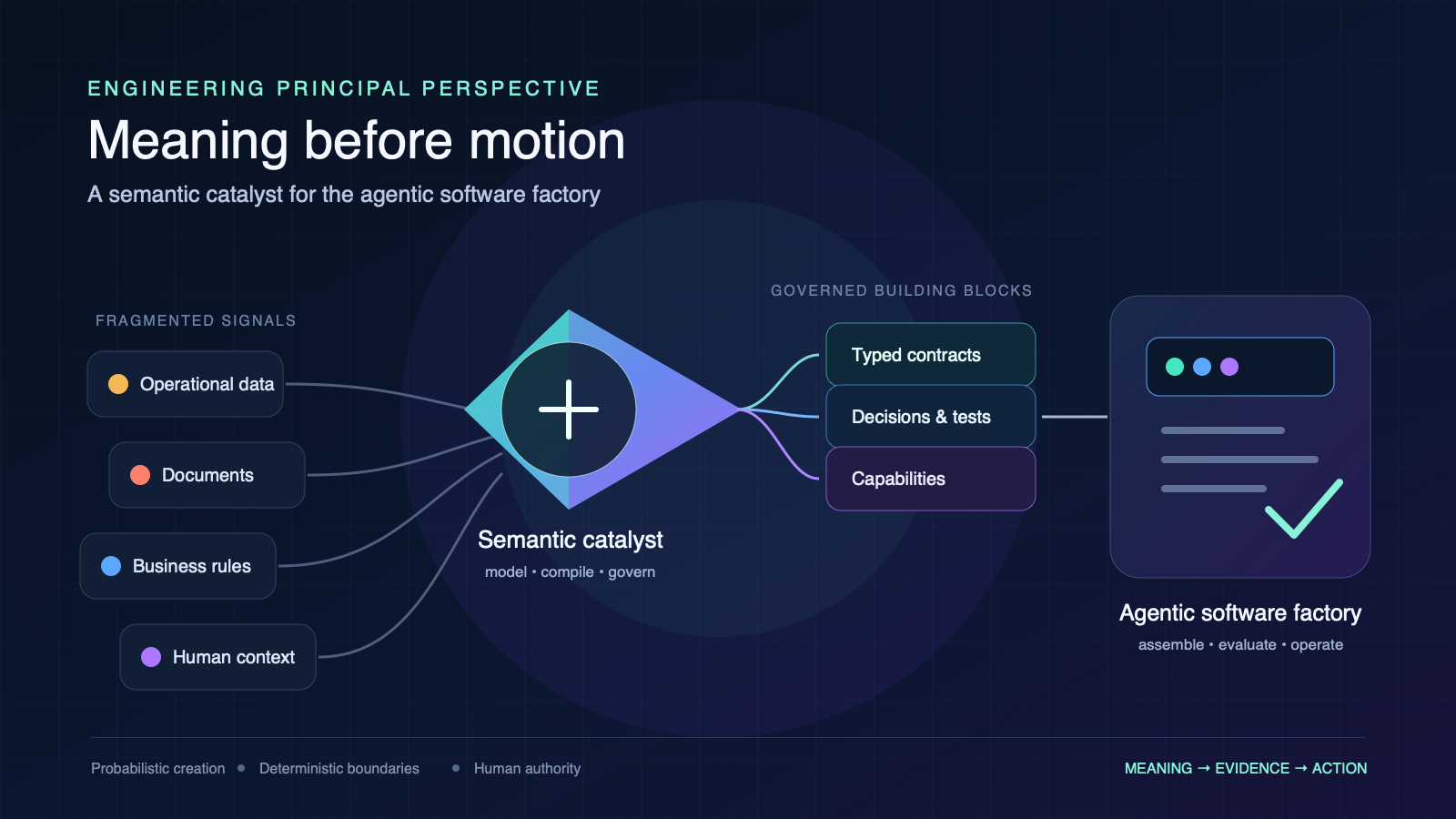
Meaning Before Motion:
A Semantic Catalyst for the Agentic Software Factory
An Engineering semantic-catalyst <–> agentic-software-factory perspective on turning enterprise meaning into governed data products, executable capabilities and safer agentic delivery.
Enterprise AI rarely fails because a model cannot generate text. It fails because the surrounding system cannot answer more basic questions reliably.
- Which “customer,” “property,” “contract,” or “service” do we mean?
- Which source is authoritative for this attribute, and how fresh is it?
- Which version of a rule produced this decision?
- May an agent only recommend an action, or may it execute one?
- Can we reconstruct the evidence, approval, and software versions behind an outcome?
Those are not prompt-engineering questions. They are architecture, ownership, and control questions.
In a recent target-system design, we approached them by combining two ideas: a semantic catalyst layer and an agentic software factory. The semantic catalyst turns fragmented enterprise knowledge into versioned, testable contracts and capabilities. The factory assembles those governed building blocks into agentic solutions, while deterministic controls and human authority remain outside the model.
The important word is catalyst. This is not a new database through which every request must pass. It is a control plane that accelerates delivery by making meaning compilable and reusable.
Why A Catalyst, Not „Just Another Semantic Layer“
Traditional semantic layers are often introduced for analytics: consistent metrics, dimensions, and reporting. That remains useful, but an agent needs more than a friendly query vocabulary. It needs operational semantics.
- Canonical entities and relationships
- Identity and source mappings
- Constraints, units, and quality expectations
- Deterministic business decisions
- Permitted actions and approval requirements
- Provenance and evidence contracts
- Machine-consumable interfaces and tests
The catalyst is therefore a design-time authority for meaning. Domain concepts are maintained as model-as-code—for example with typed schemas, relationship definitions, policy metadata, and source crosswalks. A semantic compiler transforms those inputs into a canonical intermediate representation and then into concrete outputs: data-product contracts, transformation logic, API or MCP schemas, validation code, test fixtures, and evaluation cases.
That changes the economics of the architecture. A definition is no longer trapped in a slide, an ontology tool, a dashboard model, or a prompt. It becomes a versioned input from which multiple executable assets can be derived.
The semantic catalyst does not make the model smarter. It makes the surrounding system less ambiguous.
The Target Layered Architecture
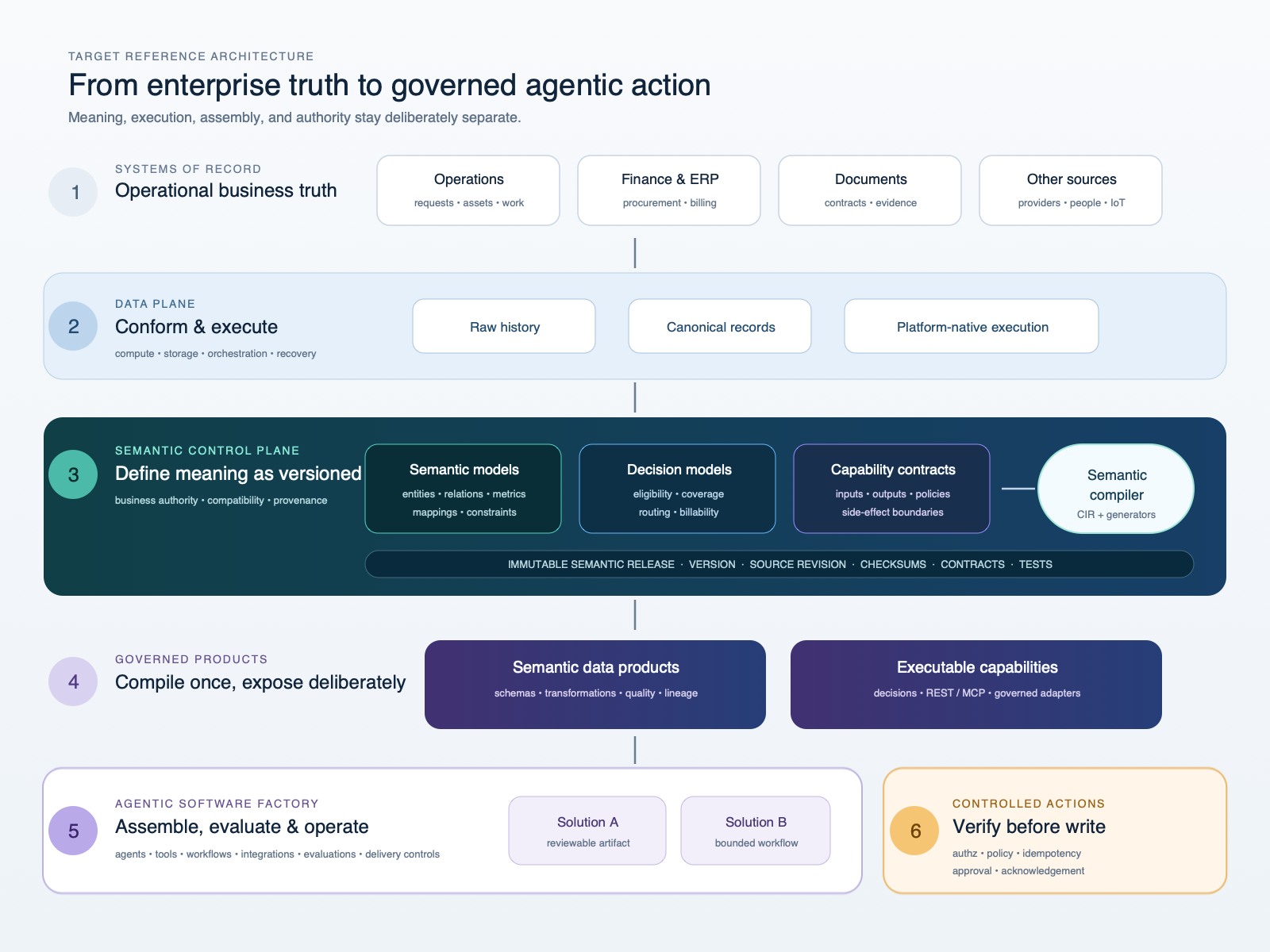
1. SoR (Systems Of Record) Retain Business Truth
Operational platforms, document stores, ERP applications, and line-of-business systems remain authoritative for their own transactions. The AI platform does not quietly replace them with a vector database or an LLM-generated shadow record.
This matters because retrieval is not authority. An embedding may help find a contract paragraph; it does not decide whether the contract is active, whether an amendment supersedes it, or whether a user may act on it.
2. The Data Plane Conforms And Executes
A cloud lakehouse or equivalent platform ingests source data, preserves raw history, and produces conformed records. It owns compute, storage, scheduling, recovery, performance, and operational data quality.
This is intentionally separate from semantic ownership. The data platform should not invent what a business concept means. Equally, the semantic team should not pretend that partitioning, incremental loading, backfills, and runtime optimization are platform-neutral details.
3. The Semantic Control Plane Defines Meaning
The control plane contains three related, but different, forms of reusable knowledge.
- Semantic models define entities, attributes, relationships, metrics, constraints, and source mappings.
- Decision models encode deterministic business choices such as eligibility, coverage, approval routing, or billability.
- Capability contracts describe governed operations such as
determine_entitlement,select_fulfilment, orpropose_invoice, including inputs, outputs, policies, and side-effect boundaries.
These inputs compile into a canonical intermediate representation: a dependency-aware, traceable description of what must be produced, without prematurely hard-coding every physical deployment detail.
4. Compilation Creates Two Kinds Of Product
- Semantic data products: canonical and purpose-specific datasets with transformations, quality rules, lineage, and acceptance contracts.
- Executable business capabilities: decision services, governed entity interfaces, adapters, REST endpoints, or MCP tools.
The distinction is useful. An agent may need historical context from a curated data product and current operational state from a live adapter. Treating every use case as either “batch data” or “real-time API” creates brittle systems. The contract should make freshness and authority explicit per field and operation.
5. The Factory Assembles Solutions
The agentic software factory consumes approved semantic models, decisions, capabilities, interface contracts, and evaluation suites. It uses them as a paved road for generating or scaffolding agents, tools, workflows, integrations, tests, and deployment configuration.
The factory’s job is not to become the business authority. It should not reinterpret a contract rule, widen a tool permission, or silently promote a generated workflow. Its value is repeatability: the same identity, policy, trace, testing, and release patterns can be applied across many solutions.
6. External Actions Cross An Explicit Control Boundary
Creating a work order, approving a purchase, changing a contract, or posting an invoice is materially different from producing a draft. External writes therefore pass through governed adapters with authorization, schema validation, idempotency, policy checks, and—where the risk requires it—human approval.
An agent can propose. Deterministic software verifies. An accountable human or policy-controlled service authorizes. The system of record commits.
How The Catalyst And Factory Reinforce Each Other
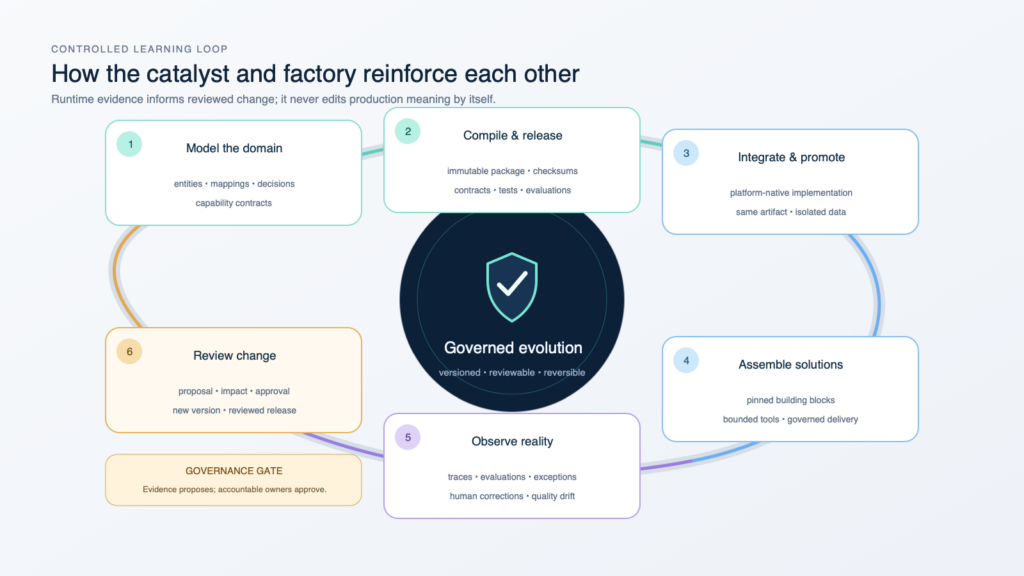
- Domain owners and engineers express business meaning as versioned models, mappings, decisions, and capability contracts.
- The compiler produces immutable semantic-release artifacts, generated implementations, tests, and evaluation cases.
- The data platform and runtime teams integrate those artifacts with platform-native pipelines, services, identities, and operational controls.
- The factory assembles bounded solutions that depend on a pinned semantic release—not on a mutable branch or whatever the model happens to infer today.
- Runtime traces, evaluation failures, data-quality exceptions, and human corrections expose where the models or capabilities need improvement.
- Those signals become reviewed change proposals. They do not directly rewrite production semantics.
This loop is the practical interplay between the two layers. The semantic catalyst gives the factory stable, meaningful parts. The factory creates multiple consumers that exercise those parts and return evidence. Over time, reuse increases while duplicated prompt logic and bespoke integration code decrease.
The architectural seam is an immutable release: a package with a version, source revision, checksums, model and mapping versions, compatibility metadata, and generated contracts. A lockfile in the consuming platform pins that exact release. Development, staging, and production receive the same definitions and code; each environment binds its own connections and loads its own approved data.
Promoting the artifact rather than rebuilding it per environment sounds mundane. It is one of the strongest controls in the design. Without it, “tested in staging” does not prove what entered production.
Probabilistic Inside, Deterministic At The Boundary
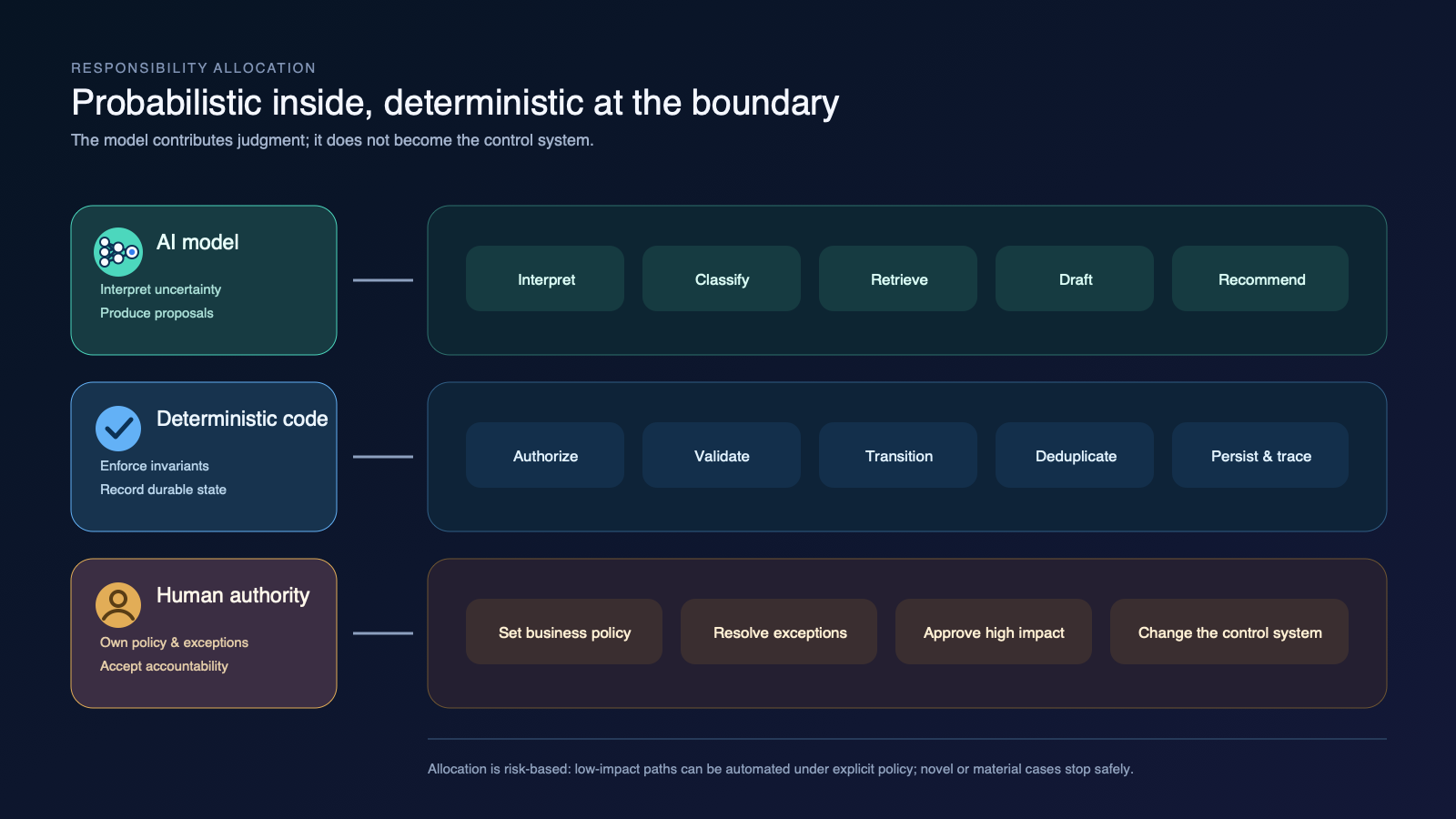
An Engineering Principal’s role in an AI transformation is partly to decide where uncertainty is acceptable.
LLMs are useful for interpreting unstructured requests, extracting candidate facts, drafting artefacts, planning within a bounded workflow, and explaining results. They are a poor place to enforce invariants such as authorization, money movement, state transitions, idempotency, or release approval.
| Responsibility | What It May Own | What It Must Not Quietly Own |
|---|---|---|
| AI model | Interpret, classify, retrieve, draft, compare, recommend | Authorization, durable state, policy exceptions, release approval |
| Deterministic service | Schemas, permissions, transitions, budgets, retries, tool scope, digests, idempotency | Unreviewed business-policy invention |
| Accountable human | Business policy, material exceptions, high-impact approval, changes to the control system | Rubber-stamping without sufficient evidence |
“Human in the loop” should not mean adding a generic approval button to every workflow. Approval points must have a named role, sufficient evidence, a clear decision, and a recorded reason. Low-risk actions can be automated under explicit policy; high-impact or ambiguous actions should stop in a state that is safe by construction.
Audit, Reconstruction & Replay
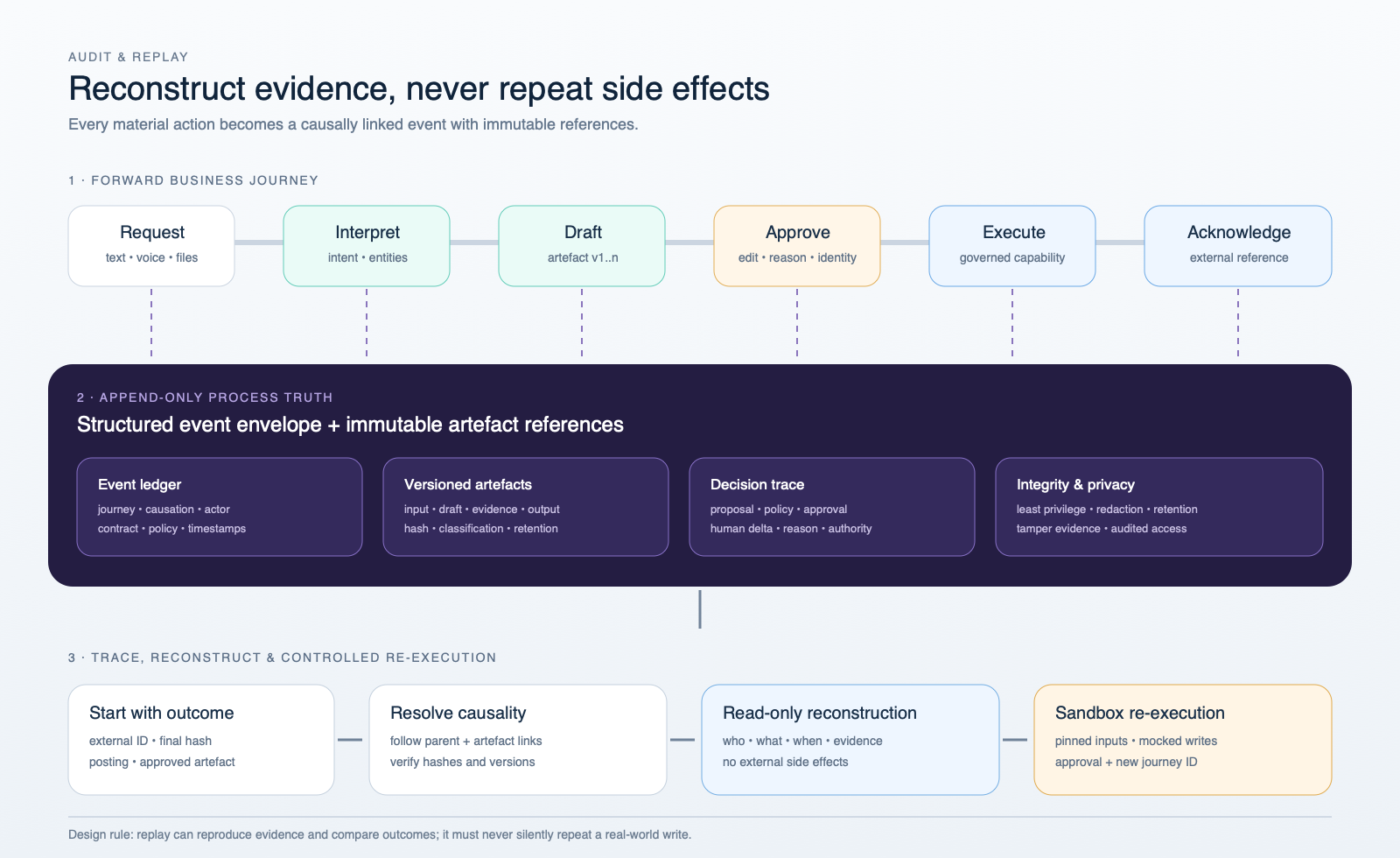
Agentic systems produce more than final answers. They produce classifications, retrieved evidence, drafts, tool calls, human edits, approvals, and external acknowledgements. If only the final text survives, the system is not meaningfully auditable.
Each material step should emit a structured event containing a journey identifier, causation and correlation identifiers, actor identity and type, semantic-contract and policy versions, and immutable references to inputs and outputs. Large or sensitive payloads belong in a governed artefact store; the ledger carries references, hashes, classifications, and retention metadata.
- Read-only reconstruction follows causality from an outcome back to the request, evidence, decisions, approvals, model, prompt, tool, and artefact versions that produced it.
- Controlled re-execution runs pinned inputs and versions in an isolated sandbox with external writes disabled or mocked, explicit approval, and a new journey identifier.
Exact replay of a generative model is not always possible, even with the same nominal model version. The realistic goal is reproducible evidence and controlled comparison—not the fiction that a stochastic service is a pure function. External side effects must never be replayed implicitly.
Trade-Offs We Should Talk About
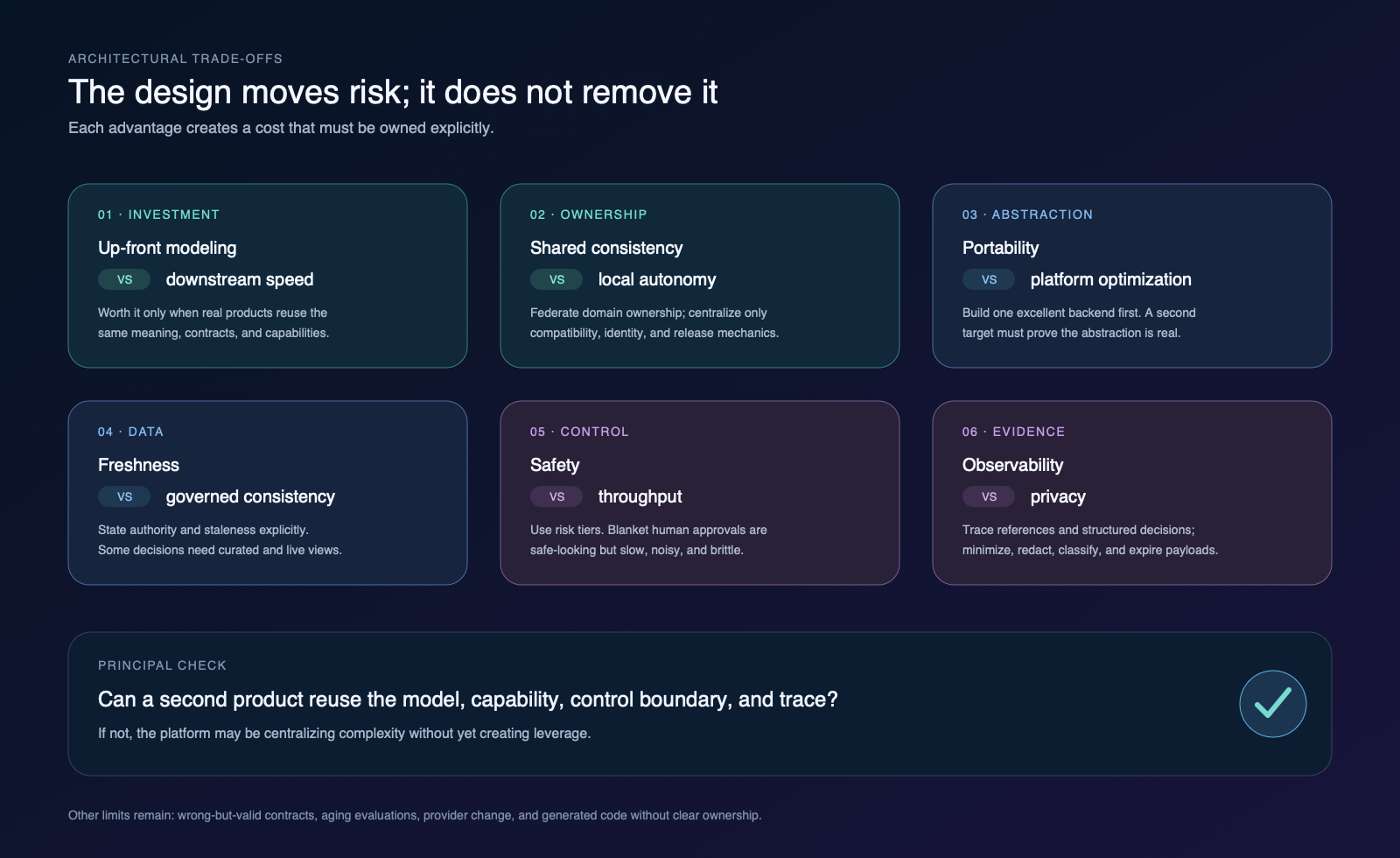
Up-Front Modeling Cost vs Downstream Speed
Canonical entities, mappings, decisions, and contracts take real domain time. The payoff arrives only when multiple products reuse them. For a one-off experiment, the architecture can be excessive. The remedy is to model vertical slices around concrete business outcomes, not to launch an enterprise-wide ontology program.
Consistency vs Local Autonomy
A shared model prevents every team from redefining “contract” or “service.” It can also become a central bottleneck. Federated ownership helps: domain teams own their bounded contexts, while a small platform group owns the compiler, compatibility rules, cross-domain identifiers, and release mechanics.
Portability vs Platform Optimization
A canonical intermediate representation creates separation of concerns, but generated abstractions eventually leak. SQL dialects, streaming semantics, identity models, deployment APIs, and observability differ. I would start with one excellent platform backend and clean boundaries, not claim a universal compiler before a second target proves the abstraction.
Freshness vs Governed Consistency
Curated data products offer reconciliation and historical context; operational APIs offer current state. Some decisions need both. Contracts should express freshness, source authority, and fallback behavior rather than letting agents guess which view is “more true.”
Safety vs Throughput
Approvals and evidence gates reduce risk but add latency and staffing cost. Blanket approvals do not scale. Controls should be risk-tiered, with policy-based automation for low-impact actions and explicit escalation for material or novel cases.
Observability vs Privacy
Rich traces improve debugging, evaluation, and auditability, but can collect prompts, personal data, or sensitive business content. Data minimization, redaction, access auditing, retention policies, and payload separation must be designed in. Hidden chain-of-thought should never be treated as an audit requirement; record structured decisions, evidence, and outcomes instead.
There are further limits. Generated code still needs ownership. Semantic contracts can be wrong while perfectly validated. Model and tool providers change. Evaluation suites age. A factory can industrialize a bad pattern faster than a team can create it manually. Architecture does not substitute for product judgment, domain stewardship, operational readiness, or security engineering.
What I Would Build First
I would not begin with a broad promise to “make the enterprise agentic.” I would choose one thin, consequential slice.
- One canonical business object and its identity rules
- One source-to-canonical mapping with explicit unknowns
- One deterministic decision or read-only capability
- One generated data contract and one governed interface
- One agent workflow that produces a reviewable artefact
- One end-to-end trace from request to evidence and approval
- One immutable release promoted through isolated environments
- One evaluation set built from real failure modes
The acceptance criterion is not an impressive demo. It is whether a second solution can reuse the same semantic release, capability contract, control boundary, and trace model with less custom work—and without inheriting hidden permissions or assumptions.
The Leadership Lesson
The hard part of enterprise AI is not connecting a model to tools. It is creating a system in which meaning, authority, evidence, and change remain legible as the number of models and agents grows.
- The semantic catalyst turns domain meaning into versioned, testable, compilable assets.
- The agentic software factory turns those assets into repeatable, governed solution delivery.
Neither is sufficient alone. A factory without semantic authority scales ambiguity. A semantic program without product delivery creates beautifully governed shelfware. Together—with immutable releases, deterministic enforcement, controlled write-back, and causal audit—they provide a credible path from AI experiments to an engineering system.
That is the transformation I find most interesting: not replacing software engineering with agents, but redesigning software engineering so that agents can participate without dissolving the boundaries that make enterprise systems trustworthy.
Illustrative Technologies
- LinkML, JSON Schema, and Pydantic for model-as-code and typed contracts
- Python for compilers, validators, services, and deployment tooling
- SQL, Spark, Delta Lake, Microsoft Fabric, and OneLake for data-plane execution
- REST and Model Context Protocol (MCP) for governed capability exposure
- Git, CI/CD, immutable manifests, checksums, and environment promotion
- Append-only event storage, versioned artefacts, and OpenTelemetry-style traces
- Policy-aware identity, authorization, secrets management, and human approval workflows
Confidentiality note: This article generalizes a target reference architecture. Customer names, internal identifiers, vendor-specific source systems, and business-specific process details have been removed or replaced with generic examples. The diagrams describe target-system intent, not a claim that every component is implemented or operating in production.